
ANTRIPODEAN IMPROVISING: Magic Squares and Carnatic-influenced Rhythmic Structures in Three Compositions by Scott Tinkler and Marc Hannaford (part 1)
Essay

This essay is adapted from a presentation I gave at the 2025 Australasian Jazz & Improvisation Research Network (AJIRN) conference in Auckland, NZ.
Thank you to Scott Tinkler and Marc Hannaford for their permission to use score and recording excerpts of their works, and to Adrian Sherriff for his assistance in my research into the Carnatic music terminology and concepts.
If you want to listen to any music being discussed, there are links at the bottom of the page.
Section 1. Introduction
This essay presents a case study of three related works by Australian improviser-composers: Oxygen Thief by trumpeter Scott Tinkler, and the twin pieces Something We Know and Something We Can Dance To by pianist Marc Hannaford.
In talking about these works, I have two goals:
Firstly, I’ll demonstrate how the three pieces are representative of an improvisational approach referred to by drummer & researcher James McLean as Antripodean Improvising: a “unique mode of improvisatory music making” that has emerged through decades of work by a small number of Australian musicians (McLean, 2018).
Secondly, I present analyses of the rhythmic structures of the pieces. All three are based on number sequences that share a number of characteristics, and I investigate how they have drawn influence from two key sources: South Indian Carnatic percussion traditions, and the mathematical concept of magic squares. These influences have been alluded to in several existing articles and interviews, but to my knowledge haven’t been explained in depth.
By analysing all three tunes in parallel, I also hope to illuminate a process of sharing and mutual development of ideas within a musical community. Tinkler’s piece was composed around 2000, and the rhythmic concepts in that work were later taken in new directions within Hannaford’s pieces, composed in 2008 and 2009, following his study and later collaborations with Tinkler.
This essay - part 1 - will look at the compositional elements of those three pieces. Part 2, which I’ll post something within the next month, will look at how those compositions are used as springboards for improvisation.
Section 2. Antripodean Improvising
The term Antripodean Improvising describes an approach to improvisation developed by a small group of East-Coast Australian musicians, and is named after the band Antripodean Collective that has been active since the late 2000’s. The musicians most commonly associated with this approach, and involved in that band, are trumpeter Scott Tinkler, pianist Marc Hannaford, violinists John Rodgers and Erkki Veltheim, guitarist Carl Dewhurst, saxophonist Scott McConnachie, and drummers Ken Edie and Simon Barker.
As mentioned above, the term Antripodean Improvising was coined by James McLean to describe the distinct musical processes present in the work created by these musicians. McLean’s framework is modelled on George Lewis’ twin hermeneutic classifiers of ‘Afrological’ and ‘Eurological’ improvising, which he proposed in 1996 to describe two historically emergent “systems of improvisative musicality”: patterns of “musical belief systems and behaviour which... exemplify particular kinds of musical logic’” (Lewis, 1996).
Lewis’s conception of ‘Afrological’ and ‘Eurological’ improvising has been hugely influential, and the terms have informed analysis of a wide range of music created around the globe. While ‘Antripodean’ improvising describes a system of musicality that is much more geographically concentrated, I believe it is a useful framework through which we can understand some unique regional developments that have been made within improvised music in Australia.
McLean developed five signifiers of Antripodean Improvising, all of which are presented below, as presented in his doctoral dissertation (McLean, 2018).
A predilection to foreground rhythm as a primary element of musical manipulation within improvisation;
A highly developed, shared, rhythmic language, combining a non-discriminatory approach to subdivision with fluent control of number grouping sequences;
An aesthetic tendency towards obfuscation; manifestations of which include frequently eliding musical pulse and a general avoidance of unified musical activity;
The combination of influence from many musical cultures... wherein overt stylistic reference is avoided in favour of repurposing procedural knowledge, and;
A democratic approach to improvisation, in which all ensemble members are expected to contribute equally, thereby eschewing any sort of soloist/accompanist duality.
The two highlighted indicators are those most prescient to my analyses of Oxygen Thief, Something We Know and Something We Can Dance To. As the next two sections will demonstrate, they exemplify the development of a complex rhythmic language that combines influence from the mathematical concept of magic squares, and methods of rhythmic organisation found within the South-Indian Carnatic percussion tradition (context for Tinkler and Hannaford’s connection to the latter tradition will also be addressed)1.
Section 3. Method of Rhythmic Organisation #1: Magic Squares
In mathematics, a magic square is an array of numbers within which the sums of each row, column and main diagonals (corner to corner) are the same, referred to as the ‘magic constant’. The number sequences in the three pieces featured in this essay use 3x3 grids2; magic squares can extend beyond the 3x3 structure, but I’ll limit the discussion to that format here.
3x3 magic squares have two generalisable properties:
The magic constant is the square’s central digit multiplied by the number of units per side, referred to as its ‘order’ (eg. a 3x3 magic square’s magic number would be the central digit multiplied by 3) (Frierson, 1907).
The total sum of the numbers within a 3x3 magic square is the central number multiplied by 9. (Webb, 2011).
Figure 1 presents an example of a magic square that demonstrates both properties. Each row, column and main diagonal sums to 15 (the central digit 5 multiplied by 3). Also, the total sum of all digits within the square is 45 (the central digit 5 multiplied by 9).

Australian bassist and composer Jonathan Dimond has worked extensively on musical applications of magic squares. He’s also an important practitioner within the Antripodean community, as a member of the band Artisan’s Workshop which featured saxophonist Elliott Dalgleish, violinist John Rodgers and drummer Ken Edie, the latter two of whom went on to become core members of the Antripodean Collective. Their work together in Artisan’s Workshop often featured the use of number sequences to generate rhythmic frameworks for improvisation, and was an important antecedent for Antripodean Collective.
Dimond has produced a resource about rhythm-based musical applications of magic squares, available on his website here. Within his conception, musical magic squares need not retain a magic constant that all rows, columns and diagonals sum to. However, they do retain “the same relationship of the middle number to the total summed value of the magic square applies” (Dimond, 2003). So, in a musical application of a 3x3 grid, the central number times nine gives us the total number of rhythmic units within the phrase.
According to Dimond, the nature of the 3 by 3 grid generates self-similar tripartite structures that, when realised musically, create what he describes as “great rhythmic cadence[s], which naturally gravitate towards the very next beat after the end of the third repetition” (Dimond, 2003).
In Dimond’s article, he includes three ‘forms’ of musical 3x3 magic squares, each with their own distinct internal mathematical relationships. The first of these forms can be found in the rhythmic structure of all three pieces this essay discusses, so we’ll look at that form only (check out Dimond’s article linked above for explanations of the other two forms). This first form can be seen in Figure 2, where each letter corresponds to a numeral.

A crucial feature of this form of magic square is that D minus C yields the extra amount by which both rows two and three increment, compared to the previous row.
Figure 3 is an example of this structural form with numbers.

The required internal mathematical relationships are all annotated, and are as follows:
- D minus C, the circled numbers, gives us 12-9=3, which is the extra amount by which the numbers within each row increment compared to the preceding row: in row one, they increase by 2; in row two, by 5; and in row three, by 8.
- The total number of rhythmic units in the square is 108 (the central digit 12 multiplied by 9).
Now that this musical magic square structure has been explained, I’ll demonstrate how it is evident in each of the three pieces. Note that these rhythmic structures are used to organise the rhythmic phrasing of the melodies in all three pieces (as opposed to other possibilities such as rhythm section phrasing or accompaniment figures). Figures mapping the number groupings onto excerpts of the notated melodies are included in Section 4 below.
Section 3.1. Magic Square: Oxygen Thief
Figure 4 features the magic square that organises the melody’s rhythmic phrasing in Tinkler’s composition, Oxygen Thief. Noticeably, the number sequence for Oxygen Thief was actually created by John Rodgers, with the melodic material and compositional arrangement written by Tinkler.

Here, a noticeable variation on Dimond’s structure is that Tinkler/Rodgers have reversed the internal order of numbers within lines one and three; instead of ABC and CEF, they are CBA and FEC respectively (according to Tinkler, this reversal was made for purely aesthetic reasons, as will be discussed in Section 4.2). Nonetheless, the line-to-line logic of the magic square remains intact. Figure 5 features the magic square with annotations highlighting its structural features (due to the reversal of numbers within lines one and three, the increase reads right to left).

Important note: as is the case with the two Hannaford compositions, Rodgers’ rhythmic design divides each of the square’s groupings into sub-groups (eg. the first cell’s grouping of 15 is divided into sub-groupings of 5-5-5). This will be important later on, but when looking at magic squares, the undivided groupings are more appropriate to demonstrate the mathematical relationships.
Section 3.2. Magic Square: Something We Know
Figure 6 features the magic square within Marc Hannaford’s composition, Something We Know.

This piece retains the ordering structure of Dimond’s magic square without any alterations. Figure 7 features presents its features with annotations.

Section 3.3. Magic Square: Something We Can Dance To
Figure 8 features the magic square of Marc Hannaford’s composition, Something We Can Dance To.

Here, Hannaford has reversed the internal order of numbers within lines one and two, but like Oxygen Thief, the large-scale structure of the magic square is unaffected. Figure 9 features presents the square with its features annotated (due to the reversal within lines one and two, the increase reads right to left).

Section 4. Method of Rhythmic Organisation #2: Carnatic Percussion Music Influence
I’ll make a disclaimer here: I am not suggesting that any of the three pieces within this essay are examples of a jazz-Carnatic fusion style. Tinkler and Hannaford didn’t design them to sound like Carnatic music, and my analysis does not suggest the works should be understood as South-Indian in nature or intent. The underlying rhythmic structures of the works do draw on Carnatic rhythmic principles to generate their rhythmic phrasing, but within an Antripodean Improvising context that is also heavily informed by jazz practice, amongst other influences.
One of the main triggers for this essay was reading the following two statements about Oxygen Thief:
“Tinkler’s methods of developing frameworks for composition include the use of… rhythmic codes derived from South Indian percussion music.” (Barker, 2015)
“It is my understanding that [Oxygen Thief’s rhythmic] structure is influenced by Indian Carnatic music, although I have been unable to find any literature to support or explicate this assertion.” (McLean, 2018)
Like McLean, I couldn’t find any specific examinations of this connection, but my curiosity was piqued and I wanted to know more.
The historical context of when Oxygen Thief was written - around the year 2000 - is significant. At this time, both Scott Tinkler and John Rodgers (who wrote the piece’s number sequence) were members of the Australian Art Orchestra (AAO), who had been collaborating with South-Indian percussionist Karaikudi R. Mani and his Sruthi Laya Ensemble since 1996, leading to a number of international tours, commissioned works and the 2000 recording Into The Fire (and the later 2009 album The Chennai Sessions).
For the Art Orchestra members, this collaboration required them to develop an understanding of methods of rhythmic organisation found within Carnatic percussion music. Their engagement with the South Indian musicians during this period of creative collaboration and development was aided by Australian trombonist and composer Adrian Sherriff, who had independently been studying Carnatic music for many years prior, and who created a booklet for AAO members giving detailed explanations of key Carnatic rhythmic processes. According to personal correspondences I had with Sherriff and Tinkler, this resource was studied by both Tinkler and Rodgers during this period, which strongly supports the idea that they utilised the processes described within the booklet when creating the structure of Oxygen Thief.
With this historical context in mind, I’ll now turn to four key concepts derived from South Indian Carnatic music. It goes without saying that this is an incredibly rich musical tradition, and having come to it through research for this essay, I am by no means an expert. The four concepts I discuss here are the ones I’ve found most pertinent to understanding the construction of the pieces by Tinkler and Hannaford, and they are by necessity given succinct explanations here; there are many resources giving far more complete explanations within the context of Carnatic-oriented research.
4.1. Rhythmic organisation principles derived from Carnatic music
4.1.1. Tala
A tala is a regularly recurring cycle of beats, roughly equivalent to the Western concept of metrical pulse. A tala’s cycle is made up of a specific number of beats: a metrical space around which played rhythmic phrases are organised.
4.1.2. Mora
A mora is one of the fundamental rhythmical cadential structures of Carnatic music, comprised of three phrases, or ‘statements’, with separations between them.
4.1.3. Karvai
Karvai is the name given to the separations between each statement within a mora. According to David P. Nelson, they can include “as part of their measurement an articulated first pulse” (Nelson, 1991) - a feature of all three pieces analysed in this essay, as we will see.
To understand the structural interaction of mora statements and karvai, we can assign the label 𝑥 to each statement of the mora, and 𝑦 to the separating karvai. With these labels, the structure of a mora can be understood as 𝑥 𝑦 𝑥 𝑦 𝑥.
Karvai are crucial in allowing the rhythmic phrasing of a mora to fit over the tala cycle’s number of beats; if the combined duration of the three mora statements doesn’t align, the karvai can be used to account for the difference, as will be demonstrated below.
4.1.4. Yati
In some moras, all of the three 𝑥 statements have the same length and content. More complex moras however feature three distinct statements, with their mathematical proportions subject to expansion or contraction, with those rhythmic shapes referred to as yati. There are six kinds of yati, with two relevant to this study - gopucca, or contraction, and srotovaha, or expansion (Iyer, 1988).
There are extremely rich and elaborate conventions governing how these transformations can be arranged, with one key principle being described by Nelson as “for three different values for ‘𝑥’... the difference in pulses between ‘𝑥1’ and ‘𝑥2’ must equal the difference in pulses between ‘𝑥2’ and ‘𝑥3’” (Nelson, 1991). As we will soon see, this principle is equivalent to the ‘increment of change unit’ within the magic square structure.
So, to summarise, a mora structure with expanding or contracting phrase lengths is now described as 𝑥1 𝑦 𝑥2 𝑦 𝑥3.
The structure of a mora is described by Nelson as “[setting] up a temporary tension with that of the tala that is usually resolved at an important structural point in the cycle” (Nelson, 1991). This is a notable aesthetic link with Antripodean improvisation and the aesthetic preference for obscuring the metrical pulse through the use of complex rhythmic grouping structures.
4.2. Carnatic Rhythmic Influence: Oxygen Thief
As mentioned earlier, John Rodgers’ number sequence for Oxygen Thief divided each grouping (seen in Figure 4) into sub-groupings. Figure 10 features the complete version of the number sequence, including the sub-groupings as well as pauses at the end of lines one and two, seen in square brackets.

As is often the case with Carnatic rhythmic cadences, the mora structure is evident on several levels here. In his work on Carnatic music, Nelson highlights the self-similar nature of mora structures, describing them as ‘fractal’, stating that their structural logic often ‘remain[s] constant at simple and complex levels of scale” (Nelson, 1991).
To examine this within Oxygen Thief, we will first treat each line of the magic square as a complete rhythmic phrase (adopting the language used by Tinkler and Hannaford). At this scale of analysis, we can see an expanding (srotovaha) mora structure of 𝑥1 𝑦 𝑥2 𝑦 𝑥3, as shown in Figure 11. The total number of rhythmic units per line is indicated on the left, where a yati of +21 can be observed between each successive line. On the right, we see the two karvai of 6, providing pauses at the ends of lines one and two.

Several characteristics of the mora form have been met here. The three-statement structure is present, and we have an srotovaha yati (increment of change in phrase lengths) with 21 extra rhythmic units per line, creating a sense of rhythmic expansion. The karvai of 6 rhythmic units has a clear structural function. Without the pauses, the rhythm cycle has a total of 180 rhythmic units, but with the two karvai included, this increases to 192, which fits perfectly over a standard 32-bar structure expressed as quavers (eighth-notes) in 3/2 meter. This structural function is analogous to the way karvai function within Carnatic music: providing pauses to allow a mora’s rhythmic cadence to align with the underlying tala cycle.
In Oxygen Thief, the mora structure is also evident on a smaller scale: within each individual line. This is reflective of what is referred to as a compound mora, within which each 𝑥 statement is itself in mora form. To demonstrate, the first line of Oxygen Thief is shown in Figure 12.

All of the mora characteristics outlined above are met here too, although with some differences. The three-statement structure is present, although this time we have a gopucca (contracting) yati, with each successive phrase having 2 fewer rhythmic units. The karvai in this case is 0 (which is permissible), so there is no pause between each statement on this structural level.
I won’t analyse lines two and three of Oxygen Thief here, but they both feature the same adherence to the mora structure, albeit with varying yati values and characters (line two has a srotovaha form, while line three has a gopucca form).
We can go one level deeper into Oxygen Thief: analysing the sub-groupings of each individual cell within the number sequence. Continuing our focus on the piece’s first line, we can see tripartite groupings of notes within each cell: 5 5 5, then 4 4 5, then 3 3 5. The mora structure isn’t quite present at this scale, but the sequence does maintain a strict sense of proportionality and patterned transformation, as shown in Figure 13.

So far, we’ve been looking solely at the underlying rhythmic principles of Oxygen Thief; we’ll now turn to how Tinkler utilised this rhythmic framework to create the piece’s composed melody. I’ll keep the scope of analysis here to the piece’s first phrase, which corresponds to the first line of the number sequence. This part of the melody is shown in Figure 14.
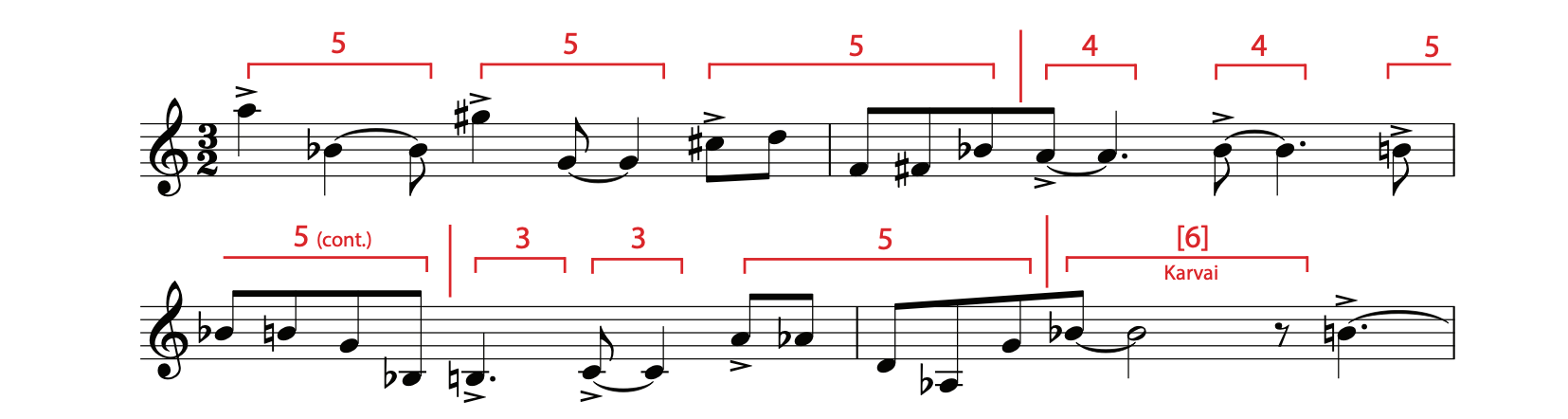
As we can see in this excerpt, Tinkler uses two distinct methods of generating played rhythms based on the number sequence, with each method acting to aurally emphasise the elements of the sequence that either change or remain constant. The final grouping of 5 within each cell is always played as a stream of five articulated quavers (eighth notes), while the preceding groupings within each cell - those that reduce in size from one cell to the next - are played with longer note durations. These latter rhythms create a clearly audible contracting rhythmic effect, while the recurring grouping of five quavers emphasise the tripartite structure within the overall phrase. We can also see that there is an articulated note on the first pulse of the karvai, providing a strong resolution to the phrase as a whole.
I’ve opted to focus on the first line of Oxygen Thief in the above analysis for brevity. However, the characteristics of Carnatic music outlined above - mora, yati and karvai - are evident within all three lines of the piece, and Tinkler’s method of creating a melody based on the underlying rhythmic structure continues for the rest of the composition, beyond the excerpt presented above.
4.3. Carnatic Rhythmic Influence: Something We Know
My analyses of the Hannaford compositions in the next two sections will be more brief, but will apply the same analytical methods as the one used for Oxygen Thief.
Figure 15 presents the number sequence for Something We Know.

Let’s look at the mora characteristics present here, and the different ideas Hannaford explored when compared to Tinkler’s Oxygen Thief.
The self-similar tripartite structure is present, with the three-statement 𝑥1 𝑦 𝑥2 𝑦 𝑥3 structure evident on the line-to-line scale, and the cell-to-cell scale within each line.
Karvai with a value of 9 used at the end of lines one and two.
On the line-to-line scale, we see a srotovaha yati shape, with a yati value of +33.
On a cell-to-cell level, each line also has an expanding srotovaha yati shape (unlike Oxygen Thief, which featured both expanding and contracting lines on this scale).
The yati value (+33) and karvai (y = 9) are both larger than those in Oxygen Thief.
The rhythm cycle (including the two karvai) has a total of 270 rhythmic units, which Hannaford expresses as 27 bars in 4/4, with the melody played in quaver (eight-note) quintuplets.
The first phrase of the melody, with the groupings annotated, can be seen in Figure 16. The way Hannaford has arranged rhythmic phrasing within the number sequence echos the technique used by Tinkler in Oxygen Thief: the first two groupings within each cell feature longer note durations, while the final grouping of 7 within each cell features a stream of quavers (eighth notes).

4.4. Carnatic Rhythmic Influence: Something We Can Dance To
Figure 17 presents the number sequence for Something We Can Dance To.

What are the mora characteristics here, and the structural differences compared to the first two pieces?
The self-similar tripartite structure, with the three-statement 𝑥1 𝑦 𝑥2 𝑦 𝑥3 shape evident on both the line-to-line and cell-to-cell scales.
Karvai with a value of 22 used at the end of lines one and two: a significantly larger value compared to the previous pieces’ karvai of 6 and 9 respectively. This means the audible separations of phrases in this piece are much more significant.
On the line-to-line scale, we see a srotovaha yati shape, with a yati value of +9: a significantly smaller value compared to the previous yatis of +21 and +33 respectively. The sense of rhythmic expansion is still present, but to a lesser degree.
On a cell-to-cell level, we have a mixture of rhythmic shapes: contracting gopucca yati in lines one and two, and then an expanding srotovaha yati in line three.
There is more variation in the types of sub-groupings used within each cell; line three in particular deviates from the uniform method of rhythmic permutation established in the first two pieces.
The rhythm cycle (including the two karvai) has a total of 224 rhythmic units, which Hannaford expresses as 16 bars in 4/4, with the melody played in quaver (eight-note) septuplets.
The first phrase of the melody, with the groupings annotated, can be seen in Figure 18.

The rhythmic phrasing utilised by Hannaford here represents a variation of that seen in Oxygen Thief and Something We Know. Within each cell, we now have a single variable grouping followed by a pair of recurring groupings of 5, rather than the single recurring grouping in the other two pieces. Hannaford retains the use of streams of quavers (eight notes) through these recurring groupings, yet because they are paired, the proportion of quavers is far greater here. The other variable groupings within the cells - 9, 7 and 5 respectively - are all phrased as long-long-short, with the length of the long notes being reduced as the groupings get shorter.
Section 5. Recordings of the Three Melodies
Now that we’ve analysed the structural properties of each piece, let’s listen to the melodies as recorded by Tinkler and Hannaford.
Videos 1-3 feature performances of each piece, accompanied by a visualiser that tracks the melody’s progression through the number sequence.
Note: all three performances have other rhythmic layers and/or arrangement features being played around the melody, which I’ll discuss in Part 2 of this essay.
The Oxygen Thief melody can be heard in Video 1, played by DRUB (Tinkler, trumpet; Carl Dewhurst, guitar; Brett Hirst, bass; Simon Barker, drums).
Video 1. Oxygen Thief melody.
The melody of Something We Know is heard in Video 2, played by Marc Hannaford Trio (Hannaford, piano; Sam Pankhurst, bass; James McLean, drums).
Video 2. Something We Know melody.
The Something We Can Dance To melody is heard in Video 3, also played by Marc Hannaford Trio.
Video 3. Something We Can Dance To melody.
Section 6. Conclusion
Part 1 concludes here, having highlighted the rhythmic organisational principles found in Oxygen Thief, Something We Know, and Something We Can Dance To, drawing on ideas informed by both the mathematical concept of magic squares, and the South Indian Carnatic musical tradition.
Returning to this essay’s goal of uncovering Antripodean Improvising characteristics within the pieces, we have seen clear evidence of both of the key stylistic indicators I highlighted in the introduction:
a highly developed, shared, rhythmic language, combining a non-discriminatory approach to subdivision with fluent control of number grouping sequences;
the combination of influence from many musical cultures... wherein overt stylistic reference is avoided in favour of repurposing procedural knowledge.
Part 2 will turn to performance-based considerations, where the second of those indicators will be demonstrated even more clearly. That essay will address the following ideas: how is each piece’s rhythmic structure realised in ensemble performance, and how do the performers draw on the compositional language during improvisation? How does the Carnatic organisational influence interact with Afrological approaches to improvisation, as well as the more local approaches developed within the Australian jazz scene?
Part 2 coming by the end of May, maybe earlier.
Listen to the music (and buy it if you like it!)
Sources
Barker, Simon. 2015. Korea and the Western Drumset: Scattering Rhythms. Surrey, England: Ashgate Publishing Limited.
Dimond, Jonathan. 2003. An Introduction To Magic Squares. Jonathan Dimond.
http://www.jonathandimond.com/downloadables/An_introduction_to_Magic_Squares-Dimond.pdf
Frierson, L.S. 1907. “A Mathematical Study of Magic Squares.” The Monist, Vol. 17, No. 2 (April, 1907); pp. 272-293.
Lewis, George E. 1996. “Improvised Music after 1950: Afrological and Eurological Perspectives.” Black Music Research Journal 16 (1): pp. 91-122.
McLean, James. 2018. A New Way of Moving: Developing A Solo Drumset Practice Informed By Embodied Music Cognition. PhD Diss. Sydney Conservatorium of Music, University of Sydney.
Nelson, David P. 1991. Mrdangam Mind: The Tani Āvartanam in Karnatak Music, Volume 1: Text and Analysis. PhD Diss. Wesleyan University, Middletown, Connecticut.
Iyer, S. Rajagopala. 1988. Sangeetha akshara hridaya: a new approach to tala calculations. Gaana Rasika Mandali, Bengaluru, India.
Webb, John. 2011. Magic Sums and Products. University of Cambridge.
https://nrich.maths.org/articles/magic-sums-and-products
While this analysis concerns rhythm only, it is worth noting that all three compositions have rigorous melodic and harmonic structures as well. For instance Something We Know features all-interval tetrachords as a prominent intervallic feature, used linearly within the melody and accompanied by contextualising chordal harmony notated in standard jazz chord nomenclature. Similarly, Tinkler’s piece utilises four dominant 7th chords, each lasting eight bars, as the piece’s harmonic cycle.
The use of 3x3 number grids to generate rhythmic structures will be familiar to many Australian readers thanks to the work of percussionist Greg Sheehan. His concept of number diamonds has had a widespread influence within the music scene here for decades, especially in recent years following the publication of his book The Rhythm Diaries (year?). However, his methods of number permutation within the diamond structure is distinct from magic squares.